
Don't Fall down the Rabbit Hole!

I admit it; I fell in love with Kamala and her campaign of joy, which stressed the best in us and charted how we could all move forward together. Like many, I was crushed when she lost. It was like a death sentence, listening to president-elect Trump gloat about the revenge he was so itching to inflict upon us.
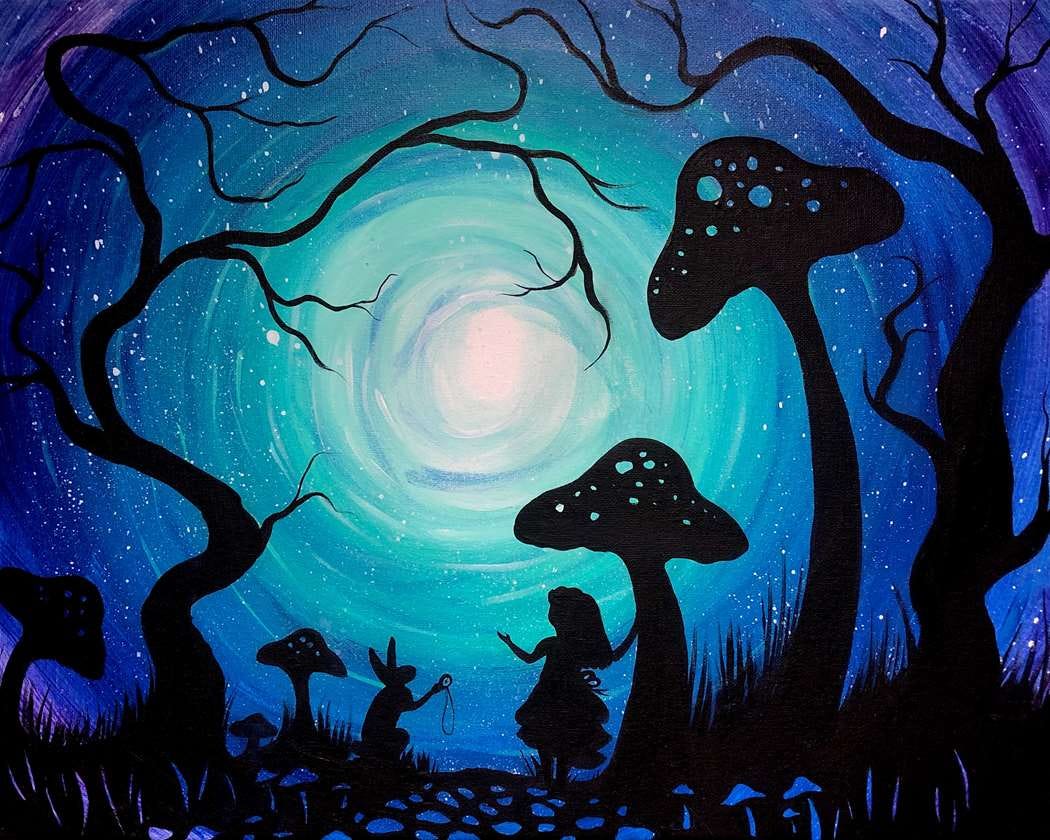
Suffering through a COVID-19 infection, I’ve had difficulty separating real news from a fever dream. In fact, I think I caught this plague because of Trump’s election, causing a collapse of my immune system. Straight out of “Alice in Wonderland,” I find myself falling down the proverbial rabbit old into the clutches of an orange-haired Mad Hatter screaming, “off with his head.”
Like in the song White Rabbit, “my mind is moving low” through my phlegm-filled head as I desperately seek direction.
But everywhere I look, democrats are spooked, quaking in their boots, too scared to offer resistance. “Liberals” like Jeff Bezos, owner of the Washington Post, Patrick Soon-Shiong, owner of the LA Times, Tim Cook, CEO of Apple, Mark Zuckerberg, along with Morning Joe and Mika, all kneeling to kiss Trump’s ring.
As Michelle Goldberg writes in the NYT, since Trump’s reelection, “many of the most influential people in America seem to have lost any will to stand up to him as he goes about transforming America into the sort of authoritarian oligarchy he admires. Call it the Great Capitulation.”1
Where is our Winston Churchill to lead us forward, to tell us we have nothing to fear but fear itself? What happened to Kamala and her uplifting campaign of hope? The Washington Post reports that she and her husband “decamped to Hawaii with a small coterie of aides to decompress and relax.”
Was she just a hundred-day wonder? Who now can I turn to for inspiration?
According to Gail Beckerman in the Atlantic,2 we need heroes like Vaclav Havel, the Czech playwright and political dissident, who refused to “accept the authoritarian’s mafioso bargain, safety and protection in exchange for keeping one’s head down.”
“The denial of life, as Havel understood it, can come about not only through accommodation—as a reasonable trade-off for more comfort—but as a result of cynicism, a feeling that nothing is worth sacrificing for.”3
Cynicism seeps into citizens’ souls, convincing them that there is nothing they can do; that they are helpless and nothing is worth fighting for. Havel, for standing up for his beliefs, spent multiple periods in prison, the longest lasting nearly four years between 1979 and 1983.
In Havel’s book, The Power of the Powerless, he described how citizens were forced to ‘live within a lie” under the Communist regime. But they never openly rebelled: ”We never decided to become dissidents. We have been transformed into them, without quite knowing how, sometimes we have ended up in prison without precisely knowing how. We simply went ahead and did certain things that we felt we ought to do, and that seemed to us decent to do, nothing more nor less."4
That’s what each of us must do today: continue to stand up for what is right, what seems to us to be the decent thing to do. Nothing more or less. Havel writes that the suffering we may experience in Trump’s wanna-be autocracy could lead us toward greater insight and freedom.
Havel argued that such oppression can never be universal as long as at least one person resists. Furthermore, the suffering endured under such a system often leads to deeper reflection: "There are times, when we must sink to the bottom of our misery to understand truth, just as we must descend to the bottom of a well to see the stars in broad daylight."5
Let the resistance begin.
xxx

Illustration Credit: PiNOTS PALETTE
Footnotes:
1 https://www.theatlantic.com/culture/archive/2024/12/what-dissidents-can-teach-us-now/680979/
2 Ibid